

ABOUT
Creative Nonfiction Mentor: One-to-One Manuscript Development
Eight sessions. Twenty-four hours. One book that only you can write.
You have pages. Perhaps a full draft with a soft centre. Perhaps a proposal that keeps not quite landing, the way a bird circles a branch three times before it commits. Perhaps three hundred pages that refuse to become a shape.
What you need is not another round of line edits. Line edits are pruning, and pruning is the last thing you do. What you need first is someone to walk the whole ground with you and find where the structure actually sits — the load-bearing walls, the paths that lead nowhere, the one view the whole book was built to frame.
That’s what this is.
I’m Kathryn Aalto. I am Creative Director of The Narrative Life teaching program and write narrative nonfiction — Writing Wild and The Natural World of Winnie-the-Pooh, both with Timber Press, the second a New York Times bestseller. I hold master’s degrees in Garden History and Creative Nonfiction, I taught at university level for years, and I’ve mentored through the Association of Writers and Writing Programs’ Writer-to-Writer programme. I’ve been teaching writers for three decades, most of them from my studio in Devon where manuscripts arrive from Sydney, Mumbai, Cape Town, Los Angeles and London.
Who this book mentorship is for
This is the right programme if you’re writing at book length in memoir, nature and place writing, biography, cultural history, travel, literary journalism, or the hybrid forms that don’t sit neatly in any of those.
It suits writers shaping a full draft, building a proposal for submission, revising a manuscript already under contract, or gathering essays that have been living separate lives and now need a spine.
It does not suit writers who want proofreading, ghost-writing, or a guarantee of publication. I can’t offer any of those, and anyone who does is selling you something.
If you’re working on standalone essays or shorter pieces, the essay-length mentorship is the better fit and costs considerably less.
What we work on: the Eight Pillars of Narrative Nonfiction
Everything I teach runs through one framework, built over thirty years of writing and teaching. It’s the architecture beneath every course I run, and it’s how we’ll read your manuscript together.
Structure, arc and pacing. A garden shows its bones in winter, when the leaves are down and nothing is hiding the shape. We’ll take your book’s leaves off. Where does it truly begin, what question is driving it, and why does the reader set it down at chapter eleven?
Voice, tone and point of view. The distance between the woman you were and the narrator you need. It is the commonest fault line in memoir and the hardest to see from inside, because you are standing on it.
Scene, setting and research. How to make a landscape carry narrative weight rather than sit in the background like scenery in a school play. And how to metabolise research — so it arrives as story, not as the sound of someone showing you their filing.
Character and lived experience. Including the questions nonfiction can’t dodge: consent, memory, representation, and what you owe the people who are in your pages without having asked to be.
Thematic clarity. What the book is about beneath what it is about — and how to make that legible without ever saying it aloud.
Chapter architecture and transition. Scaffolding, sequence, and the joins. Books rarely fail in their chapters. They fail in the gaps between them.
Momentum and stakes. Why a reader turns the page when nothing is exploding. This is the quiet engineering that separates a book people admire from one they can’t put down.
Positioning. Where your book stands on the shelf, who it stands beside, and what an agent needs to see happen in the first ten pages.
How the mentoring works
What you send. Up to 10,000 words, or 40 pages, before each session. Any stage of draft. Messy is welcome — messy is often more useful, because a rough draft still shows its seams.
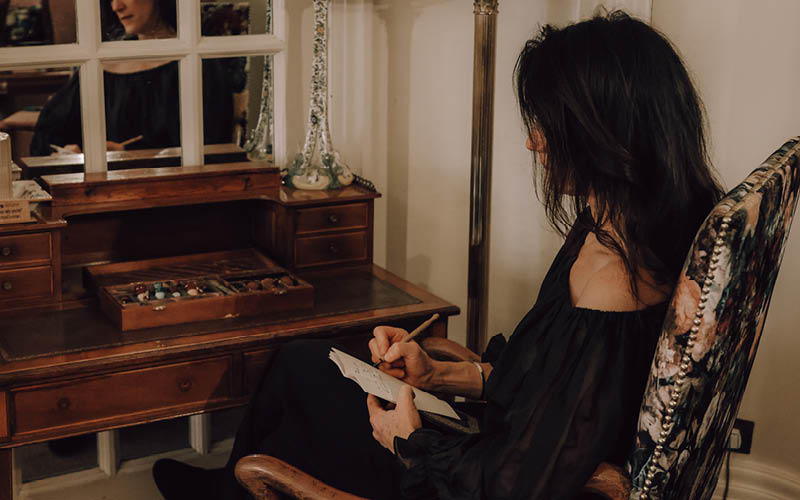
How I read. I put your pages in a leather satchel and walk into town to a café, or carry them to the sunlit corner of my studio, and read for ninety minutes without interruption. No inbox, no notifications, no other book in my head. I annotate by hand on a reMarkable, so what returns to you is my own handwriting — marginalia, arrows, question marks, and every so often a drawn diagram of your own structure, which is frequently the moment a writer sees the book plain for the first time.
It is a slower and closer kind of attention than most editorial feedback, and that is deliberate. Books are not built at speed.
Your written assessment. Before we meet you receive a full written assessment: what is working, what is structurally at risk, and three concrete priorities for the next revision.
Our session. Then, ninety minutes on Zoom, scheduled to your time zone and your writing rhythm. Not a lecture. A conversation between two working writers about a book in progress — affirmation where it’s earned, and clear direction where it isn’t.
Three hours of undivided attention on your manuscript, for each of our eight meetings.
Meetings run at whatever pace the writing wants, usually across six to eighteen months. Some writers meet monthly. Others go quiet for a season to draft, then surface with a hundred new pages and a changed mind.
Why work with a nature and creative nonfiction specialist
Most book coaches are generalists, and if you’re writing about landscape, place, environment, gardens, natural history or the more-than-human world, that generality has a real cost. You spend the first session explaining the field before you can get any help with the book.
I’ve spent my working life in this territory. Writing Wild is a study of twenty-five women who shaped nature writing, which meant taking apart the genre pillar by pillar to see how it stands up — I’ve thought structurally about this form more than almost anyone teaching it. I’m a trained garden historian, a trustee and international ambassador of the Ashdown Forest Foundation, and affiliated with the Orto Botanico in Rome. I know the publishers, editors, prizes and comparable titles in this space, because it is my space.
I also know it from the other side of the desk. Three books published, one New York Times Bestseller, a speaking career.
BENEFITS
What you leave with
A manuscript with a structure that holds. The most common reason a good book doesn’t sell is not the sentences. It is that the architecture gives way somewhere around the middle, and the writer — too close to see it — keeps polishing the rooms while the walls lean. Eight rounds of structural reading is enough to find that, and enough to fix it.
A clearer sense of your own voice. Not a voice I’ve given you. Most writers arrive with theirs already intact and buried under the one they think they’re supposed to use. Much of this work is subtraction.
Momentum across a long project. A book takes longer than enthusiasm lasts. Knowing that someone is reading your pages on a fixed date, closely and in full, does more for a draft than any amount of resolve. Several of my mentees describe the deadline as the thing that got the book written.
A working knowledge of how publishing actually operates. What a proposal has to do, what an agent is looking for in the first ten pages, which houses publish work like yours and which don’t, how long everything takes, and what a contract does and doesn’t mean. I can’t introduce you to an agent, and I’d be wary of anyone who says they can. What I can do is make sure you understand the room before you walk into it.
An honest reader. Praise where it’s earned and a clear account where it isn’t. I have been published, been reviewed, and been rejected a great deal, and I will tell you plainly which of your problems are craft problems and which are the ordinary weather of a writing life. You can’t solve the second kind, only outlast them.
A practice that continues after we finish. The reading habits, the structural questions, the way of looking at your own pages — these are the parts that stay. Writers who’ve worked with me tend to leave with a method for diagnosing their own drafts, which is the point. The aim is not that you need me for the next book.
TESTIMONIALS
“Kathryn was a fabulous mentor at a time when I needed it most. I was working on the manuscript of my first nonfiction book. She provided wonderful advice about how to balance different chapters, how to better tell a story, and always reminded me to be specific rather than vague. She gave me courage to pursue interviews with higher-profile people than I would have otherwise approached. Working with her in the final stages dramatically improved my final product.” — McKenzie Long, California, author of This Contested Land (University of Minnesota Press)
“Less than a year after we started, I have had five of the six essays she critiqued accepted for publication. Kathryn did more than just review and suggest — she recommended books and articles I should read, authors I should follow, conferences I should attend.” — Andrew W., Maine, AWP Writer-to-Writer mentee
“Kathryn Aalto is a world-class teacher. I had thirty years’ experience as a journalist and copywriter, but I was a novice in narrative nonfiction. She taught me how to write, revealing the secrets of sensory writing, bringing filmic vividness to my descriptions of the world around me and uncovering the inner landscapes of the mind.” — Gary F., Rutland, England
“She is highly adept at refining one’s technical skills without stifling a writer’s voice. I love the combination of rigour and nurturing she provides. Without her mentoring, I would still be stumbling in the dark along my path to publication.” — Lise P., Glendale, California
“With Kathryn’s teaching and support I developed a book proposal that brings together seemingly disparate subject matter into compelling narrative nonfiction. I’m difficult to teach, and she realised this early on. She guided and pushed me in constructive ways to question myself and my direction.” — Heather D., Leeds, England
COST
Mentoring Package: £4500
This comprehensive mentoring package is designed for writers of creative nonfiction who seek in-depth guidance, structured support, and expert feedback to elevate their work.
£4,500 for the full programme.
Eight one-to-one sessions, each comprising a ninety-minute close reading, a written editorial assessment delivered in advance, and a ninety-minute Zoom conversation. Up to 10,000 words or 40 pages read per session — 80,000 words across the programme, which for most writers is the whole book.
Scheduling is flexible across six to eighteen months. Payment can be arranged in instalments.
For comparison: three one-hour sessions is the standard offering at the large UK institutions. This is eight sessions of three hours, with one reader who holds your entire book in mind from first page to last.
I take a small number of these each year, because the reading is the work and the reading takes time.
Frequently asked questions
How is this different from a developmental edit? A developmental edit is a report on a finished manuscript. This is a sustained relationship across a draft — eight rounds of reading, response and revision, so the book changes shape while we are inside it rather than after.
What if I don’t have a full draft yet? That’s common, and often ideal. Structural problems are far cheaper to solve at 20,000 words than at 90,000.
Do you work with writers outside the UK? Yes. Most of my mentees are elsewhere — the US, Australia, South Africa, India, across Europe. Sessions are scheduled to your time zone.
Do I need to have published before? No. Several of the writers quoted above hadn’t published a word of nonfiction when we started.
What genres do you take? Memoir, nature and place writing, biography, cultural and garden history, travel, literary journalism, essay collections, and hybrid work. I don’t take fiction, poetry, or business and self-help nonfiction.
Can you guarantee I’ll get an agent? No, and I’d be wary of anyone who says otherwise. What I can do is make sure the manuscript an agent opens is the strongest version of the book you are capable of writing.
Start the conversation
Every mentorship begins with a free conversation about your project, your ambitions, and whether I’m the right reader for your book. Sometimes I’m not, and I will say so and point you towards someone better suited.
Email kathryn@kathrynaalto.com with a paragraph about what you’re writing and where you’ve got to.