
I have been teaching writers for thirty years, and the question I am asked most often about my online nature writing course is some version of this: can you really learn to write the living world from a screen?
I understand the doubt. Nature writing is about mud and weather and standing still in a field until your feet go numb. But the writing of it happens where all writing happens: at a desk, alone, trying to find the sentence that holds what you saw. What a class gives you is not the field. It is the craft to carry the field home.
Why I Teach Nature Writing Online
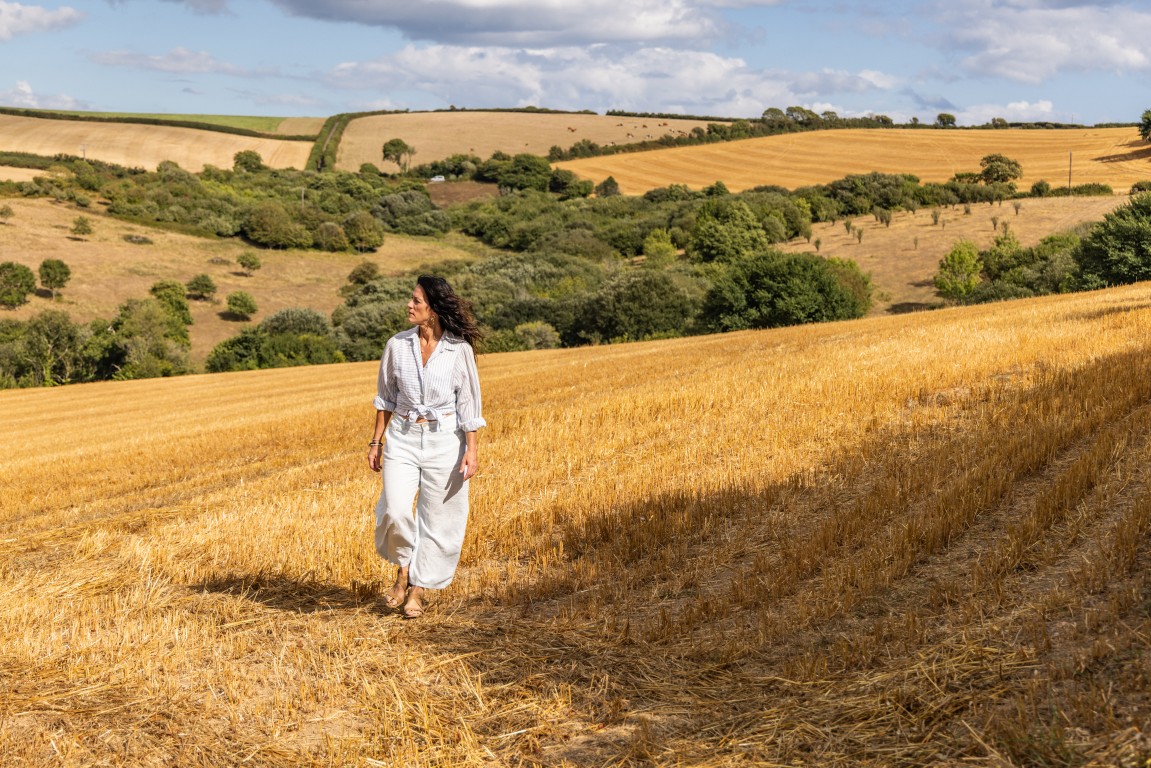
As you can see above, I live in beautiful Devon, England, and I write about people, plants and places. My students live in Nairobi and Portland and Cologne and Fayetteville. Six continents, in one Zoom room, every fortnight.
That reach is the argument for an online nature writing course. A writer in Arkansas hears how an Australian describes light on water. Someone who has spent a career in science listens to a poet parse the same estuary. The genre gets larger in the room, and so does everyone’s sense of what their own patch of ground might hold.
The Eight Pillars: What You Learn in This Online Nature Writing Course
Everything I teach rests on the Eight Pillars of Narrative Nonfiction: presence, arc, character, dialogue, voice, language, setting and resonance. In the Level 1 nature writing course we take them one at a time, and you apply each to your own pages before we move on.
Presence. How a narrator stands in a landscape without blocking the view of it.
Arc. Why a walk is not yet a story, and what turns one into the other.
Character. People, and also herons, rivers and trees, rendered with the depth a novelist gives a protagonist.
Dialogue. Speech that reveals, including the speech of the farmer, the ranger, the neighbour who has watched this valley for fifty years.
Voice and language. Sentence sculpting: rhythm, precision, the difference between bird and jackdaw.
Setting. Place as an argument rather than a backdrop.
Resonance. How one hedgerow becomes every reader’s hedgerow.
Observation Is a Discipline, Not a Gift
The core belief underneath the course is that the best writers are the closest readers, and the closest readers are the closest observers.
So we practise observation as a skill you can improve, the way you improve scales. We read Henry Beston’s The Outermost House alongside contemporary essays. We open every session with a poem, read aloud twice, because ten minutes inside a poem retunes the ear for everything that follows. Students who arrive certain they are “not poetry people” are usually the ones bringing poems to share by the end.
One student put her own learning better than I could:
My most significant learning is in how to listen, and that being there with ears wide open always yields an enriching engagement with nature’s vast range of voices.
How the Course Actually Runs
Eight sessions across a term, live on Zoom, in a small group. Each session moves through the same architecture: a greeting where I take what I call a meteorology of the room, the poetry portal, a craft lecture built on close reading, a break, discussion, and workshopping in small groups. Writing exercises thread between them.
You write four essays across the term, alternating with close-reading sessions, so that every new idea meets your own pages while it is still warm. Every piece comes back with detailed feedback, much of it handwritten, sometimes with sketches in the margins. I respond to the writing as it unfolds: the sentence that sings, the paragraph that has more to give, the instinct you may not yet know you have.
What My Students Have Gone On to Do
Nearly all of my writers arrived without having published a word. Since then, students who began in these foundational courses have:
- won the £10,000 Nature Chronicles Prize
- been named Bradt New Travel Writer of the Year
- been shortlisted for the Fish Memoir Prize
- signed book contracts, including with Timber Press
- published essays in national magazines, literary journals, anthologies, and books from university and general presses
Most went on into Levels 2 and above, where guest authors including Kathleen Jamie, Andrea Wulf, Ross Gay, Stephen Moss, Rob Cowen, Diane Ackerman, and Camille Dungy join the room live.
What Writers Say About This Online Nature Writing Course
I was apprehensive, as a new writer, when I signed up to Kathryn’s Level 1 Narrative Nature Writing class. There’s something very scary about sharing your work for the first time! As it turned out, I needn’t have worried. This class delivered so much more than I had expected.
— Toni, England
I had thirty years’ experience as a journalist and copywriter, but I was a novice in narrative nonfiction. Kathryn taught me how to write, guiding me on a journey of discovery, revealing the secrets of sensory writing, bringing filmic vividness to my descriptions of the world around me.
— Gary, Rutland
Kathryn’s magic created a haven for aspiring writers and poets. Spending two hours with other writers from around the globe filled my creative well and sustained my writing practice. The best part is the community remains.
— Laura, Fayetteville, Arkansas
She has an unparalleled knowledge of nature and landscape writing that gives a real gravitas and authority on the subject, a knowledge that she wears lightly without intimidating students.
— James Rebanks, author of The Shepherd’s Life
Who This Nature Writing Course Is For
Beginners, mostly. People who have kept a notebook for years and never shown it to anyone. Scientists and academics who want to write in a voice that sounds like a person. Gardeners, birders, walkers, grievers. Retired journalists. Anyone who has stood somewhere beautiful or damaged and thought: someone should write this down.
You do not need a degree, a publication, or a finished idea. You need a notebook and a willingness to be surprised by what you notice.
Joining the Next Term
Level 1 is where the path begins, and it is the prerequisite for the intermediate and advanced courses that follow. Places are limited, because the room only works when it is small enough for everyone to be heard.
You can find dates, tuition and more on my course page. Once registered, I will send you the syllabus. Bring the patch of ground you cannot stop thinking about. We will start there.